
Free Download: Accessible Communication During Aquatic Emergencies

Updated: Oct 1
First-aid training teaches aquatic professionals a lot about what to ask. What happened? Where does it hurt? Are you allergic to anything? Do you feel dizzy? Can you take a deep breath? Staff practice these interactions repeatedly until the assessment feels almost automatic. Most training scenarios also include a patient who answers.
Now imagine the person is conscious and clearly trying to communicate, but the standard verbal exchange is not working. They may be nonspeaking, use AAC, be Deaf or hard of hearing, speak another language, have an intellectual or developmental disability, or be experiencing enough pain, fear, sensory overload, or stress that communication is temporarily more difficult.
The responder still needs information, but repeating “Where does it hurt?” louder is probably not going to solve the problem. An inclusive first-aid communication tool gives responders more than one way to gather information and explain what is happening.
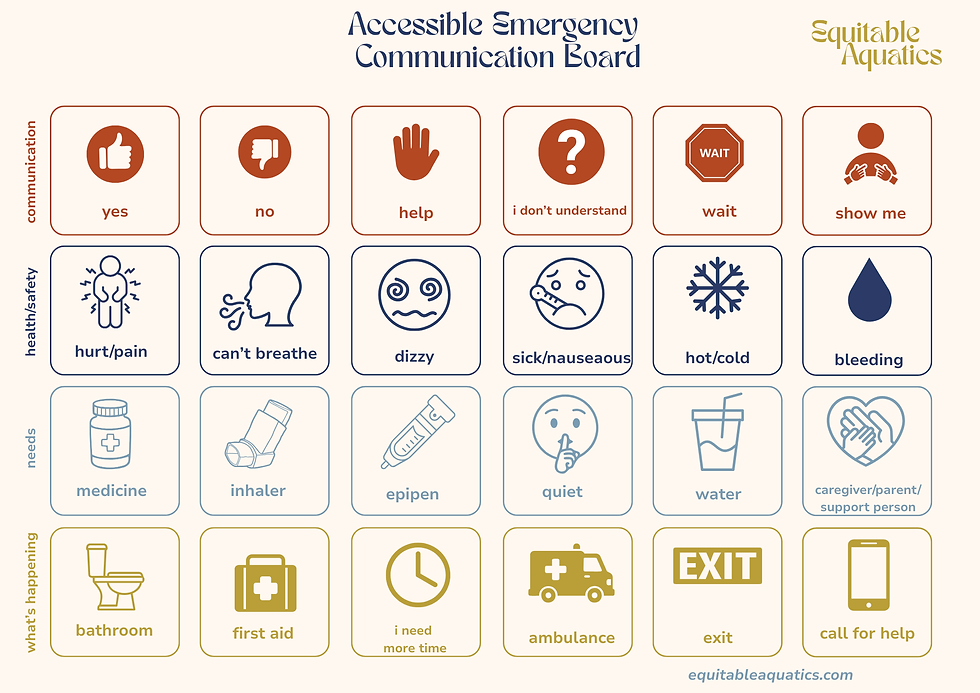
To make this easier to put into practice, I created a free two-page Accessible Emergency Communication Board for aquatic professionals. You can download, print, and laminate it for your first-aid station, emergency bag, and other response equipment. The board includes quick communication options, common symptoms and needs, emergency information, a body map, and ways for someone to communicate how they want responders to assist them.
Start With the Most Important Communication
Emergency communication tools should be simple enough to use when everyone involved is stressed. Before worrying about dozens of medical terms, make sure the person has access to the basics.
Essential quick communication might include:
YES
NO
I DON'T KNOW
I DON'T UNDERSTAND
STOP
HELP
WAIT
AGAIN
SHOW ME
WRITE IT
MY COMMUNICATION DEVICE
SUPPORT PERSON
These concepts can be combined with pointing, gestures, written communication, body diagrams, AAC, and other communication methods.
Staff should continue speaking directly to the person whenever possible. Someone who does not respond verbally may understand everything being said. A communication difference should never become an invitation to begin discussing the person exclusively with whoever is standing beside them.
What’s Included on the Communication Board
When I designed the downloadable board, I wanted enough information to make it useful without creating a wall of symbols that becomes difficult to navigate during an emergency. The information is organized into sections so a responder and the person receiving care can move through the interaction more easily.
The free two-page board focuses on high-priority communication, immediate needs, common symptoms, what is happening, a body map, and ways someone can communicate how they want responders to assist them. No single board can include every communication need or emergency situation, though. When developing or expanding communication resources for your own facility, these are some of the categories worth considering:
Category | Examples to Consider |
1. Quick Communication | Yes, no, stop, help, wait, don't understand, show me |
2. What Happened? | Fall, hit, cut, burn, water, sick, allergy, other |
3. How Do You Feel? | Hurt, dizzy, nauseous, breathing difficulty, numb, cold, hot, weak |
4. Where? | Front and back body diagram |
5. Pain | No pain, a little, medium, a lot, worst |
6. What Happens Next? | First aid, wait, ambulance, hospital, support person, calling for help |
7. Communication & Support | Speak, point, write, sign, AAC/device, pictures, explain first, more time |
8. Language Access | Professionally translated high-priority emergency communication |
Breaking information into categories also helps the responder. Instead of searching a crowded board while managing an emergency, they can move logically through the interaction. Your facility may also identify additional words, symbols, languages, or supports that make sense for the community you serve.
Include a Body Map
On the back of the downloadable board, I included front-and-back body images. This may be one of the simplest and most useful pieces of the entire tool. Instead of requiring someone to identify or describe a location verbally, the responder can ask them to point to where it hurts or feels different.
For example:
Responder: “Show me where it hurts.”
The person points to the right ankle.
The responder then shows:
LITTLE | MEDIUM | A LOT
The person points to A LOT.
That exchange is not a complete medical assessment, but the communication barrier has been reduced enough for the responder to gather useful information while continuing the care required by their training.

Think Beyond Questions
Emergency communication should not become something responders use only to extract information. The person receiving care also needs to understand what is happening.
The back of the downloadable board gives the person receiving care ways to communicate about how help is provided, including TOUCH, DON'T TOUCH, HELP ME MOVE, DON'T MOVE ME, GIVE ME SPACE, EXPLAIN FIRST, and I NEED MORE TIME. These options won't apply in every emergency, but when circumstances allow, they give responders another way to support communication, autonomy, and consent.
Useful messages might include:
I am here to help.
I am going to check you.
Can I touch your arm/leg/head?
I need you to stay here.
We are calling for more help.
An ambulance is coming.
Your parent/caregiver/support person is coming.
You can use your communication device.
You can point or write.
Tell me STOP if you need me to pause, when it is safe to do so.
These messages can reduce uncertainty and give someone more information during an already stressful experience.
Emergency care will sometimes require responders to act quickly, including circumstances where physical contact is necessary to protect life or prevent serious harm. Communication accessibility does not change appropriate emergency protocols. It does encourage staff to explain what they are doing and preserve autonomy whenever circumstances allow.
Don't Depend Entirely on Facial Expression for Pain
Many common pain scales rely heavily on illustrated facial expressions. That may be useful for some people, but facial expression is not a universal indicator of pain.
A person may report significant pain while appearing calm. Another person may smile or laugh when anxious. Some autistic people communicate emotion or physical discomfort differently than responders expect. Culture, disability, trauma, stress, and individual personality can all affect outward expression.
Consider pairing any visual scale with plain-language descriptions:
NO PAIN | A LITTLE | MEDIUM | A LOT | WORST
The individual remains the primary source of information about their own pain whenever they are able to communicate it.
Language Access Needs More Than Google Translate
A communication board with pictures can help when staff and patrons do not share the same primary language, but pictures are not a universal language and should not be treated as one. Critical medical and emergency phrases should be professionally translated when possible rather than created through casual machine translation and assumed to be accurate.
A small translation card could prioritize phrases such as:
Are you hurt?
Where does it hurt?
Can you breathe normally?
Are you allergic to anything?
Do you need medication?
We are calling emergency medical services.
Please stay here.
Can we contact someone for you?
Show me how you communicate.
Point to yes or no.
The languages included should reflect the community the facility actually serves rather than a generic national list.
The downloadable board is not a replacement for language access. It is one additional communication support that may help bridge a communication gap while appropriate language services are accessed.
Put It With the Equipment
Once you download the Accessible Emergency Communication Board, don't let it become another resource that lives in a computer folder. If a communication tool is intended for an emergency, staff should not need to remember where someone saved it. Print it, laminate it, and put it with the equipment staff will actually grab.
Attach a compact version to the first-aid bag. Keep another at the primary first-aid station. If your organization uses trauma bags or mobile emergency equipment, consider whether a version belongs there as well. Then use it during training!
A good in-service scenario would be to tell the person playing the patient that they cannot answer verbally. The responder has access to the normal first-aid supplies and the Accessible Emergency Communication Board. Afterward, ask:
How long did it take staff to change communication strategies?
Did someone simply repeat the questions louder?
Was the board easy to navigate?
What information was missing?
Did responders explain what they were doing?
Did they continue communicating directly with the patient?
Where should the resource physically live?
You may discover that the resource itself needs improvement. That is exactly why we practice.
An Inclusive First-Aid Kit Is More Than Supplies
Aquatic organizations spend substantial effort making sure first-aid kits contain enough bandages, gloves, gauze, and other required supplies. Communication deserves a place in that readiness conversation too.
A person should not receive a lower quality of care simply because they communicate differently than the person staff practiced with during certification class. A few thoughtfully designed tools cannot eliminate every communication barrier, but they can give responders alternatives when their first method does not work.
Download the Free Accessible Emergency Communication Board
I created this free two-page Accessible Emergency Communication Board to give aquatic professionals another tool when verbal communication isn't working. Download it, print it double-sided, laminate it, and add it to your first-aid or emergency response equipment.
But don't wait until an emergency to introduce it. Use the board during staff training and emergency scenarios so responders have an opportunity to practice changing their communication strategies before they need to do it in a real situation.
This resource is intended as a communication support tool. It does not replace first-aid training, emergency medical protocols, professional interpretation, an individual's existing communication system or AAC, or organization-specific emergency procedures.


